Multilayer ceramic capacitors (MLCCs) are small but significant devices of modern electronics, powering everything from smartphones to laptops by enabling efficient charge storage and delivery. These tiny yet complex components feature interleaved nickel electrodes and advanced perovskite ceramics such as barium, zirconium, or strontium titanates. At the nanoscale, their performance depends on intricate phase transformations and grain boundary chemistry, including segregation at core–shell interfaces, which are critical factors for device reliability and efficiency.
Join Katherine Rice as she takes you inside the latest research from the CAMECA Applications Lab. This session will explore cutting-edge specimen preparation techniques, reveal insights into grain boundary segregation, and discuss yield optimization using the newest generation of CAMECA atom probe technology. There will be a live Q&A after the recorded presentation.
On Demand at our Thinkific website: https://apt-training.cameca.com/courses/High-Impact-APT
Download the one-page summary by clicking here.
Presenters:
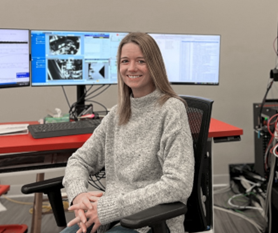
Dr. Katherine Rice
Applications and Market Development Manager
CAMECA
Dr. Katherine Rice is an Applications and Market Development Manager with Cameca Instruments in Madison, WI. She received her PhD in Chemical Engineering from the University of Colorado-Boulder and completed an NRC postdoc at NIST-Boulder. Her research interests include transmission EBSD, nanoparticle synthesis, and atom probe tomography.

Severin Jakob
Postdoc researcher
Institute of Thermomechanics, Czech Academy of Sciences
Dr. Severin Jakob has studied material science at the Montanuniversität Leoben and received his PhD at the Chair for Physical Metallurgy and Materials Testing there. He recently completed a 3-year postdoc position at the Department of Physics, Chalmers University of Technology, focusing on Atom Probe Tomography and exploring the features of the newest generation of LEAP instrumentation. Research topics included precipitation-hardened steels, Ni-base alloys and oxides.